 Pest Control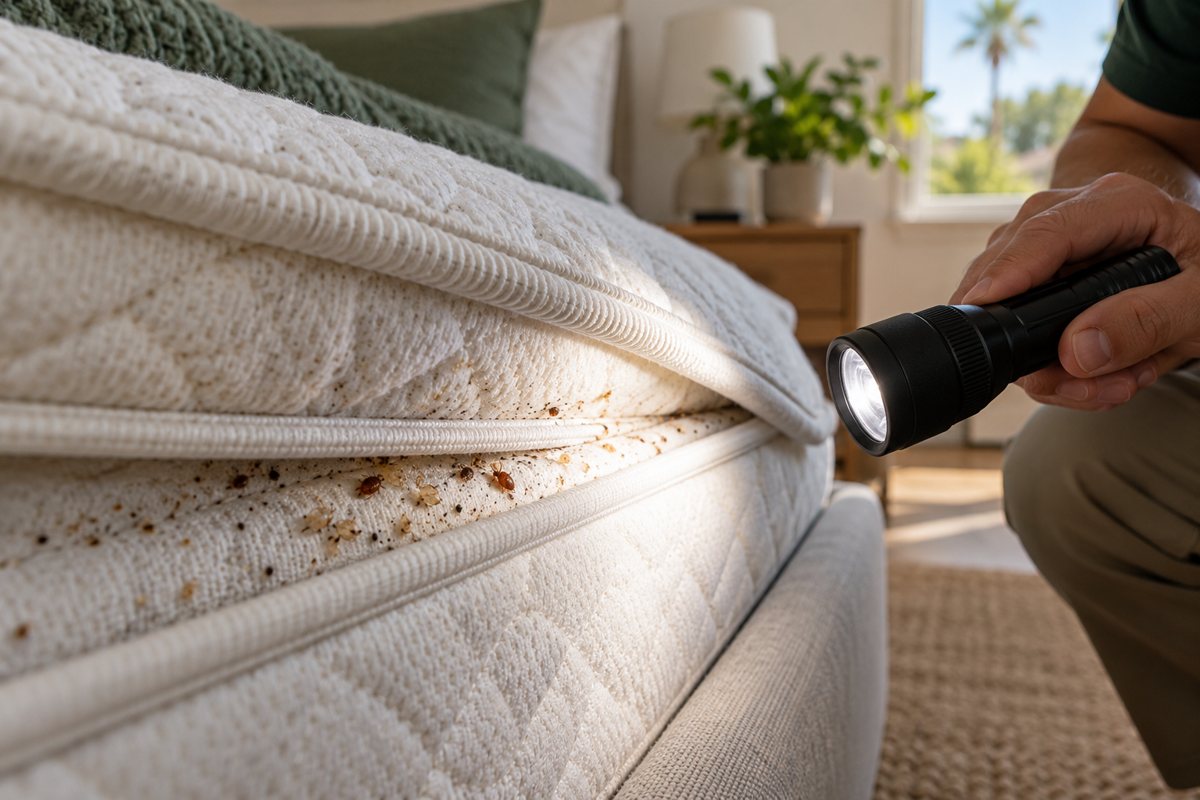
The practical starting point
Bites can cause understandable concern. However, they do not reliably identify bed bugs.
Physical evidence, room context and inspection provide a more useful basis for the next step.
Separate symptoms from pest evidence
An itchy mark is not a confirmed identification. UC IPM explains that bites from different arthropods can be difficult or impossible to distinguish reliably. [1]
If you have a health concern, seek medical advice.
For the pest enquiry, focus on what is visible in the room rather than asking a website to diagnose skin symptoms.
This distinction can prevent unnecessary treatment decisions.
You can request help while remaining uncertain; a careful account of uncertainty is better than a confident diagnosis based only on bites.
Physical signs give the inspection a starting point
UC guidance describes bugs, spotting, eggs and shed skins as relevant evidence. [1] The location and appearance of a finding still need assessment.
Take a photograph of what you can see safely and include a wider view of the affected area.
A close image without scale or location may be difficult to interpret.
Do not assume every mark on a mattress is bed bug evidence.
Ask for identification and an explanation of the findings before choosing a service or disposing of belongings.
Record the room and the resting space
Describe whether the concern involves a bed, sofa, guest room or another resting area.
Note when the evidence first appeared and whether it has been found more than once.
You do not need to dismantle furniture to make the initial call. The provider can explain the appropriate inspection access and preparation.
If you have already moved bedding or belongings, mention that.
A clear history of what changed helps the assessment without blaming the occupant or assuming how the concern began.
Travel history is context, not proof
Used furniture or a recent trip may be relevant information to share. UC explains that bed bugs can be transported with belongings. [1]
Neither detail proves the source at your property. Avoid making an accusation against a hotel, neighbor or retailer from a timing coincidence.
For the enquiry, keep the history factual: when an item arrived, where it was placed and when evidence appeared.
The purpose is to help determine what should be checked, not to assign blame before identification.
Do not spread the inspection problem
EPA recommends avoiding movement of suspect items into unaffected areas when preparing for control. [2] Ask the provider how belongings should be managed.
Do not rush to carry a mattress through shared corridors or move everything into a second bedroom. Unplanned movement can make the scope harder to evaluate.
If you need to move an item for daily living, explain the constraint and ask for handling guidance.
A practical plan should account for the people living in the home, not rely on an impossible instruction to stop using every room.
An inspection has boundaries
Ask which rooms and items will be inspected and what access is needed. Dense storage, occupied units and inaccessible components can limit the findings.
A photograph review and a property inspection are different services. Clarify what the provider can conclude from each.
In a managed building, identify who can authorize adjoining-space access. The affected unit may not be the entire inspection scope.
However, the provider cannot assume permission to enter or treat neighboring areas.
The plan should explain the evidence
EPA outlines identification, planning, preparation and evaluation as parts of bed bug control. [3] Those stages help explain why the next decision should follow confirmed findings.
Ask what evidence supports the recommendation, which spaces need service and how progress will be checked.
Avoid interpreting every generic pest-control page as a promise of the same method.
If professional heat or another specialist approach is discussed, confirm actual availability and the preparation it requires.
Our educational guides do not establish that every method is supplied by the business.
Keep a record that helps follow-up
A dated room log is easier to review than a list of symptoms without locations. Record physical findings and share photographs when requested.
Do not invent a population count from scattered spotting or assume that every new mark is fresh.
Ask the provider how to interpret the evidence you have recorded.
Monitoring instructions should explain what matters and when to report it.
Clear follow-up questions help you understand the plan without making a universal promise about the number of visits.
Ask before throwing furniture away
Disposal is a practical decision with handling and replacement costs. Do not assume every suspected item must be discarded before inspection.
Ask whether it can be assessed, included in the proposed treatment or managed another way. The answer depends on the item and actual scope.
If disposal is recommended, request instructions for moving and handling it.
Keep the decision separate from fear: replacing an item does not by itself explain whether other spaces or belongings still need assessment.
An example: itchy marks after a trip
Imagine returning from travel with itchy marks but no visible pest evidence. The timing can be reported.
However, it should not become a confirmed bed bug diagnosis or an accusation against a hotel.
For health concerns, use an appropriate healthcare professional. For the pest enquiry, describe the rooms used and any physical findings that can be photographed safely.
Ask about assessment before throwing away furniture or moving bedding into another room. The inspector can clarify what evidence exists and which spaces need consideration.
This approach addresses uncertainty without forcing the occupant to identify the pest from symptoms alone.
Prepare for the first call
Have the address, ZIP code, affected rooms and dates ready. Explain any photographs or physical evidence without handling the bugs to obtain a sample.
Pest Control El Cajon covers qualifying addresses in 92019, 92020 and 92021. Ask for a bed bug assessment and clarify inspection scope, access and next-step costs.
A useful first conversation reduces uncertainty.
It should tell you what information is needed and how the assessment will be arranged, rather than requiring a diagnosis before you can get help.
A simple decision checklist
Use this table to organize observations and questions. It does not diagnose the pest or prescribe a treatment.
The next step should fit the evidence and the property, with appropriate professional assessment where needed.
| What you notice | What to record or do | What to ask |
|---|---|---|
| Bites only | Separate health and pest enquiries | What physical evidence needs assessment? |
| Marks near mattress | Photograph with location | Can identification be supported? |
| Suspect belongings | Avoid unplanned movement | What handling guidance applies? |
Keep a copy of the scope and any instructions alongside your notes.
If observations change, explain the new location or timing separately so the provider can review the situation accurately.
The example above is hypothetical. It illustrates a decision process and is not a customer story, completed project or claim about a treatment result.
Frequently asked questions
Are bites enough to identify bed bugs?
No. Physical evidence and inspection are more useful; health symptoms belong with a healthcare professional.
Can I send a photo?
A clear photograph and the location can help the initial enquiry. It may not replace a property assessment.
Should I discard the mattress immediately?
Ask for inspection and handling guidance before making a disposal decision.
Sources and further reading
References support the factual pest information in this guide. The checklists and hypothetical examples provide practical questions for an enquiry.
Follow instructions for the actual assessed work rather than treating general educational guidance as a treatment plan.
Sources accessed October 8, 2026. Publication dates on linked resources may be earlier. Coverage, pricing and methods must be confirmed for the actual property and service.
Discuss the relevant service
Read the service scope, then call with your address and observations. Qualifying service addresses are within 92019, 92020 or 92021.
Call for a Free Quote