 Pest Control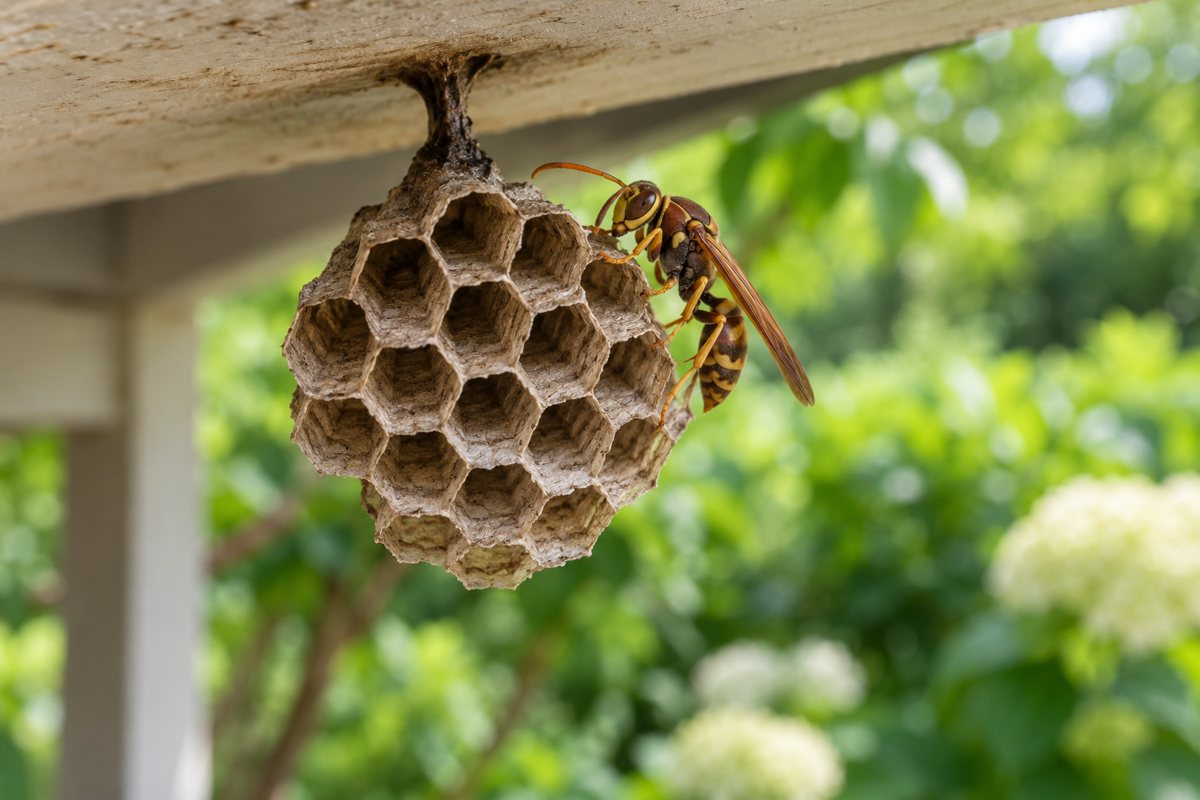
The practical starting point
Identification and nest location should guide the next step. Observe from a safe distance and avoid disturbing an active nest to get a closer look.
A name should follow the evidence
People often use wasp, yellowjacket and bee loosely when describing a stinging insect. An assessment should distinguish them before a method is selected.
UC IPM discusses paper wasps and yellowjackets separately, including differences in their appearance and nests. [1] Those distinctions help explain why identification matters.
For the first enquiry, say what you can safely observe. You do not need to catch the insect or approach the nest to confirm a name.
A distant photograph and location can be enough to start the conversation.
Appearance can help, but do not get closer
Paper wasps are generally more slender in appearance than yellowjackets. Color alone can be misleading because several insects share yellow and dark markings. [1]
If your photograph is unclear, say so. The provider can discuss whether inspection is needed rather than forcing a confident identification from a poor image.
Do not handle a dead-looking insect or use a ladder to get a close-up.
The value of the image does not justify changing a safe observation into contact with the activity.
Nest structure provides useful context
An open-cell paper nest may raise a paper-wasp question, while yellowjacket nest settings can differ. UC guidance describes these distinctions. [1]
The homeowner’s task is to report the location, not to expose the nest.
Activity into a wall or ground opening should not be disturbed to reveal what is inside.
Ask how the assessment will account for concealed areas. Physical removal, treatment, access and later building repairs may be separate parts of the proposal.
A busy flight path needs a practical boundary
Describe whether activity is near a door, seating area, walkway or shared entrance. That context helps establish how the property is used.
Keep people and pets away from the immediate activity while arranging appropriate assessment. Do not obstruct an active opening or improvise a nest-removal attempt.
The site does not publish nest-removal instructions.
A general comparison article should help with an enquiry, not persuade a reader that they can safely perform specialist work after learning the insect’s name.
Not every outdoor sighting has the same significance
An insect passing through a garden and repeated traffic into a particular opening are different observations.
Record the pattern without assuming one means a nest is nearby.
UC discusses the ecological role of these insects as well as pest situations. [1] The service goal should therefore relate to the activity affecting use of the property.
Ask whether intervention is appropriate and why. A useful assessment explains the decision rather than claiming that every wasp anywhere outdoors must be eliminated.
Discuss access before comparing prices
A reachable visible nest and activity inside an enclosed space can involve different work. Explain the building feature and whether the area is occupied.
Ask what the price covers: assessment, treatment, removal, specialist access or repairs. Do not assume a broad nest-service description includes opening and reinstating a wall.
For a shared building, identify who can authorize access and work. A tenant’s concern does not automatically provide authority to alter common areas or neighboring spaces.
Bee work is a separate capability question
Do not assume a wasp-control provider also supplies every kind of bee service. Explain the evidence and ask about the actual capability offered.
If identification is uncertain, avoid choosing a service by an online resemblance.
The appropriate next step can be a professional assessment or a referral to a suitable specialist.
This business does not advertise bee, bat or protected wildlife services without confirmation. Educational discussion helps visitors understand the question.
However, it is not a claim that every related service is supplied.
Precautions depend on the actual work
Ask how the area should be kept clear before and after service, and what observations should be reported. The instructions need to fit the selected method.
Do not use a generic number of hours from another product as permission to approach a nest. Obtain the actual guidance from the provider.
EPA’s broader IPM framework supports selecting methods from identification and the situation. [2] Applied here, that means asking for the reasoning and work boundaries instead of relying on a universal quick-fix claim.
Keep medical and property concerns separate
If someone has been stung and is unwell, seek appropriate medical assistance. The pest enquiry concerns the property and does not provide a diagnosis.
Mention a household sensitivity or access concern when coordinating service, but do not rely on the website to assess a person’s condition.
For the property record, note the location and activity pattern. A clear distinction between health help and pest assessment ensures each question reaches the appropriate professional.
An example: flight into a wall opening
Imagine repeated stinging-insect flight near a wall opening by a patio.
There is no visible exposed nest, and the homeowner is unsure whether the insect is a wasp or a bee.
Do not block the opening or remove a panel to find out.
Describe the location and keep people away from the immediate activity while seeking identification and assessment.
Ask whether the provider can assess the insect and what concealed-space work would involve. Treatment, opening the building and repairs may have different boundaries.
A clear scope prevents a generic nest-service quote from being mistaken for a complete wall-access and restoration package.
Prepare for a useful El Cajon call
Have the ZIP code, nest location and safe photographs ready. Explain whether the activity affects a home, patio, business or shared access route.
Our coverage is limited to qualifying addresses in 92019, 92020 and 92021. Ask about identification, available service, access and any work exclusions.
The next step should make the plan clearer.
You should understand what is being assessed, what work is proposed and what instructions apply without disturbing the activity yourself.
A simple decision checklist
Use this table to organize observations and questions. It does not diagnose the pest or prescribe a treatment.
The next step should fit the evidence and the property, with appropriate professional assessment where needed.
| What you notice | What to record or do | What to ask |
|---|---|---|
| Uncertain insect | Observe from distance | Is identification needed? |
| Concealed activity | Do not block or expose it | What does assessment include? |
| Shared entrance | Identify access authority | How should the area be coordinated? |
Keep a copy of the scope and any instructions alongside your notes.
If observations change, explain the new location or timing separately so the provider can review the situation accurately.
The example above is hypothetical. It illustrates a decision process and is not a customer story, completed project or claim about a treatment result.
Frequently asked questions
Can color identify the insect?
Not reliably by itself. Several insects share similar markings, and a clear image or inspection may be needed.
Should I block the flight opening?
Do not disturb or block an active opening before professional assessment.
Does wasp service include building repairs?
Only if explicitly agreed. Confirm concealed-nest access and repair exclusions.
Sources and further reading
References support the factual pest information in this guide. The checklists and hypothetical examples provide practical questions for an enquiry.
Follow instructions for the actual assessed work rather than treating general educational guidance as a treatment plan.
Sources accessed October 8, 2026. Publication dates on linked resources may be earlier. Coverage, pricing and methods must be confirmed for the actual property and service.
Discuss the relevant service
Read the service scope, then call with your address and observations. Qualifying service addresses are within 92019, 92020 or 92021.
Explore wasp & yellow jacket control
Call for a Free Quote